Is Body Shop At Home A Pyramid Scheme?
Table of Contents
This post may contain Affiliate Links
Have you been invited to join The Body Shop at Home recently? You’re not alone. If you’ve done some research, you might be wondering whether The Body Shop at home is a Pyramid Scheme, Multi-level marketing company or a genuinely good work from home opportunity.
With the recent rise in the cost of living many people are looking for ways to make extra cash, especially when they can’t stretch the money they do have any further.
I’ve seen so many people join The Body Shop at Home recently and honestly my heart breaks for them a little every time I see it.
Social media seems to be awash with work from home opportunities, many of which seem genuine.
If you’ve been approached to join The Body Shop at Home I can see why you might be tempted. The Body Shop is a well-known company that most people have heard of so it doesn’t seem dodgy or like it could be a scam.
The online advertisements often entice those struggling for cash with incentives such as ‘no upfront fees‘ and ‘work from your phone‘ along with anecdotes about how this ‘amazing opportunity’ has changed the posters’ life for the better.
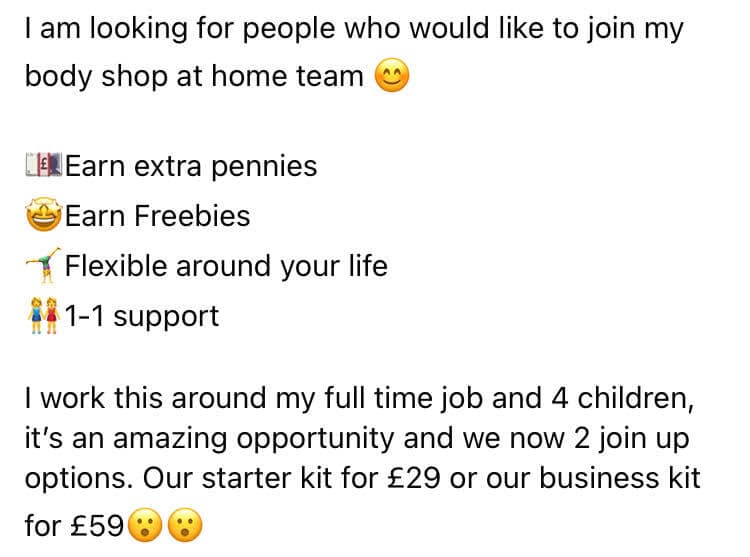
And you might be thinking that selling some well-known products to friends and family via Facebook would be a great way to make a bit extra in these tough times.
However, there are some massive red flags when it comes to Body Shop at Home.
Is The Body Shop At Home A Pyramid Scheme?
Well, technically, no, it isn’t.
But hear me out.
Pyramid schemes are illegal and don’t involve products. With a Pyramid scheme, you pay to join and then make your money back by recruiting others and taking a cut of their joining fee.
The higher up the pyramid you go, the more money you make. It’s illegal and a total scam. See also: Pozi Scheme.
Because Body Shop at Home involves selling products, as well as recruiting new members, it isn’t technically a Pyramid scheme.
However, that doesn’t automatically make it a good way to make money.
So if Body Shop at Home isn’t a Pyramid Scheme, what is it?
Body Shop At Home Is A Multi Level Marketing Company
Body Shop At Home is a multi-level marketing company.
A multi-level marketing company is very similar pyramid scheme but with products to sell. The further up the pyramid you are, the more money you’re likely to make.
However, those in the bottom tiers of the business are likely to earn next to nothing, because of the way the commission is structured. In fact, on average only 1% of people in MLMs make money.
Why Are Multi Level Marketing Companies Bad?
Just like with a pyramid scheme, those at the top of Multi-Level Marketing companies are the ones making all the profit.
The few people that make money from Multi-Level Marketing do so because they have managed to recruit a huge team, known as their downlines, and they take a cut of the money those people make each month.
‘Isn’t that just how any business works though?’
I hear you cry!
‘Those at the top make more money than those at the bottom who are earning minimum wage!’
Well no.
Because even with a minimum wage job, you still get paid that wage, whether the business makes one sale that week or one thousand sales. You also get other benefits like holiday pay sick pay and a pension scheme.
With multi-level marketing, you only make money when you sell products.
And even then, it’s only a small commission on the products you sell. To make £1000 a month you’ll need to sell 535 Body Shop products worth £7.50 each based on their current commission structure.
Eventually, those in multi level marketing companies end up recruiting others because they can earn more money from recruiting people than they do from selling the products.
Unfortunately, that’s not the only reason multi level marketing companies are bad. Here are some of the other shady things they do – these apply to most multi level marketing companies, The Body Shop at home included.
High-Pressure Selling and Recruitment
Often when you join a multi level marketing company you’ll be added to several chats on either Facebook Messenger or Whatsapp. These will often include your upline, their upline and other members of their teams.
Here you’ll be sent training materials, pre-written social media posts and various selling tactics.
While you may find some teams are genuinely lovely, on the whole, uplines put a lot of pressure on their teams to make money. Because of course, if you’re not making money, their not making money either.
Teams are encouraged to post on their personal social media several times a day and reach out to people they’ve not spoken to in years to attempt to recruit them as well as pestering family and friends.
This can lead to fractured relationships and alienation from those around them with sales leaders saying that anyone that doesn’t support their ‘business venture’ or that questions the multi level marketing company.
There is also the tatic of telling people that any negative comments from friends and family are based on jealousy and should be blocked. You may also be told you’re simply not working hard enough even when it feels like you’re pushing as hard as you possibly can to get sales.
Targeting Vulnerable Groups
Multi-Level Marketing companies specifically target vulnerable groups, such as those that want to work from home because of a disability or new Mum’s who have maybe lost income due to maternity leave or not returning to work after having a baby.
According to research, 99% of people in MLMs lose money (source) and in many cases that’s money that they can’t really afford to lose.
Add in the pressure from uplines, being desperate to make it work and save face as well possibly alienating friends and family with all the spammy social media selling, MLMs can be hugely detrimental to people’s mental health.
Fake It Till You Make It
Almost all Multi-Level Marketing companies have a culture of ‘Fake It Til You Make It’ meaning they encourage members to lie on social media and to friends and family about how much they are earning, how many hours they are putting in and how easy it is to make money.
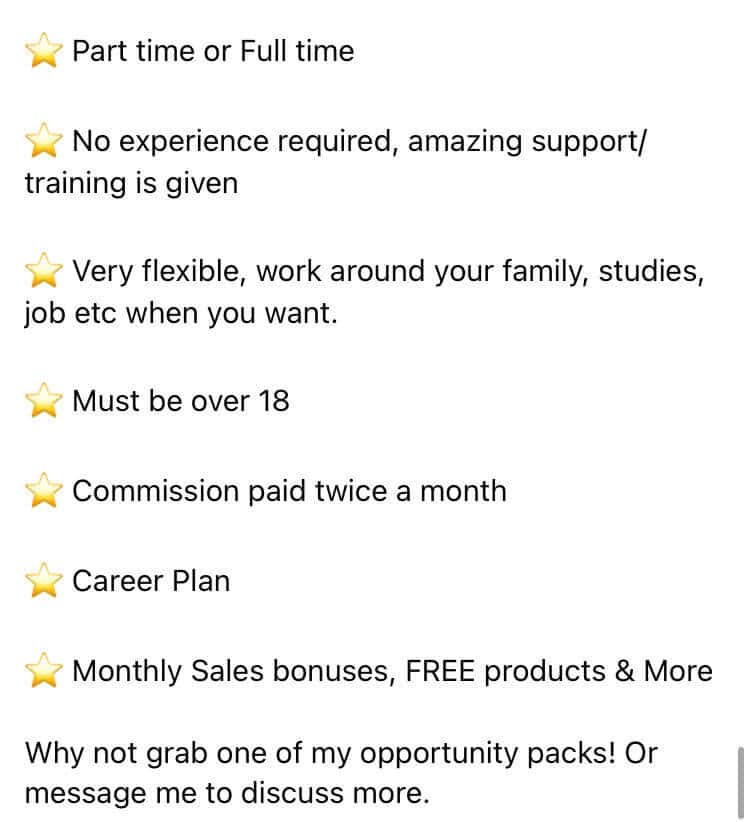
You might also see people mention that they got a free car or holiday (more common in the USA than here in the U.K) and while these claims might have some truth, it’s definitely not the whole truth.
For example, with the car, it’s a credit agreement in your name that the company only pays while you’re making a certain amount of commission. Fail to hit that and you’re fully responsible for the cost.
Illegal Facebook Raffles
Have you seen these raffles on Facebook? To be fair I’ve seen them run by both people in multi level marketing companies and legitimate small businesses too.
You’ll be asked to buy a number from 1 to 40 for £1. You are then in with a chance of winning a prize worth £30. The business then pockets the difference.
According to the U.K Gambling commission, this is illegal. Raffles can only be run for charities or good causes and not for commercial gain.
Most of the people running these raffles probably don’t realise what they are doing is wrong, but it’s a shady practice that is hugely encouraged within MLMs.
It’s also against Facebook’s community guidelines, so if you run another business from Facebook as well as your MLM you risk losing your account.
Making People Believe They Run A Small Business
When people are part of a multi level marketing company they’re often told that they’re running their own small business.
You may see them post on their social media saying things along the lines of ‘People will spend £3.50 on a Costa Coffee, but not on a product from my small business!’
As someone who runs a small business myself, I often buy from other small businesses run by my friends and family but I won’t buy anything from anyone involved with multi level marketing.
Those in multi level marketing companies are simply salespeople that are working on a commission-only basis. They don’t create products and without the products from the company, they wouldn’t have a business.
No Income Disclosure Statement
Many multi level marketing companies don’t put out an income disclosure statement. This means there is no way for anyone to check whether people within the company are actually making money.
If sales reps are really making as much as they say they do, why wouldn’t the company proudly display it? Those that do display data often choose the best parts to make the company look better than it actually is.
Should You Join The Body Shop at Home?
If you’re remotely tempted to join The Bodyshop at Home please, please don’t do it. There are lots of great ways to make extra money from pet sitting to blogging – joining a multi level marketing company is not one of them.
Just to recap, here are a few reasons not to join The Body Shop at home.
- 99% of people in multi level marketing companies either lose money or don’t make any money at all.
- The average person in an MLM makes £25 a month before expenses (this is not profit) and only 2/3 make a sale each month
- Little return for the hours spent posting on Facebook, chasing orders etc. this number rarely comes close to minimum wage.
- Many MLM reps end up getting into debt buying stock that they are unable to sell.
- Running dodgy raffles could get you banned from Facebook.
- Pressure sales and recruitment tactics could alienate you from friends and family.
- Being a sales rep for Body Shop at Home is not the same as running your own small business.
- Toxic culture that targets vulnerable people.
- Basically a cult (I wish I was joking but I’m not)
List Of Multi Level Marketing Companies
Of course, The Body Shop at Home is far from being the only multi level marketing company out there.
Some are more well known than others, but here is a list of the most common ones in the U.K so if you are ever offered ‘An Amazing and Life-Changing Business Opportunity’ via Facebook Messenger, you can check if it’s a Multi-Level Marketing company.
Ann Summers
Arbonne
Avon
Forever Living
Herbalife
Juice Plus
LulaRoe
Monat
Neal’s Yard Remedies
Scentcy
Utility Warehouse
Usborne Publishing
Younique
You may have heard of some of these and not even realised they are multi level marketing companies or that the business in question has a direct selling arm.
How To Help Someone In A Multi Level Marketing Scheme
If you have a friend or family member that’s stuck in a multi level marketing company you might be wondering the best way to help them get out.
It can often seem like people in MLMs have been brainwashed and it can be really difficult to break through that toxic cult-like culture to actually get through to them.
The first thing to do is not to buy their products or share their social media pages. This can give false hope that their business venture will be a success when anyone who’s done any research will know 99% of people in MLMs don’t make money.
This also means they’ll be tempted to buy more stock as the stock they have is selling well. While many in MLMs may find they have the initial support of friends and family, these few initial sales will not be sustainable long term, especially for expensive products or items you’d only buy a few times a year such as mascara.

Confronting them with your concerns can often cause problems as the person’s upline will be ramming fake success stories down their throat. Instead, maintain contact but don’t buy from or actively engage with the MLM.
One way you may be able to help them is to offer support with accounting and properly tracking the hours spent vs money made. Over time this may slowly show them that they’re not making a profit and hopefully could eventually be the catalyst they need to get out.
If it’s someone you truly care about then be there for them without retribution when they finally see the light.
Another option could be to stage a full-scale intervention, something you can read more about here: Getting out of an MLM.
Further Reading
Looking to find out more about The Body Shop at Home and other multi level marketing companies? Here are some great places for further information.
Follow Hattie.Rowe on TikTok – Hattie makes fun videos looking at how bad multi level marketing companies are (I love her, she’s brilliant!).
Elle Beau – Elle shares her journey of selling Younique products.
How Much MLM Sellers Really Make – Interesting infographic talking about how much you’d need to sell to make the average U.K income of £31k.
MLM Truth – Run by several ex MLM reps who share their stories.